The U.S. takes Hawai'i: Imperialism
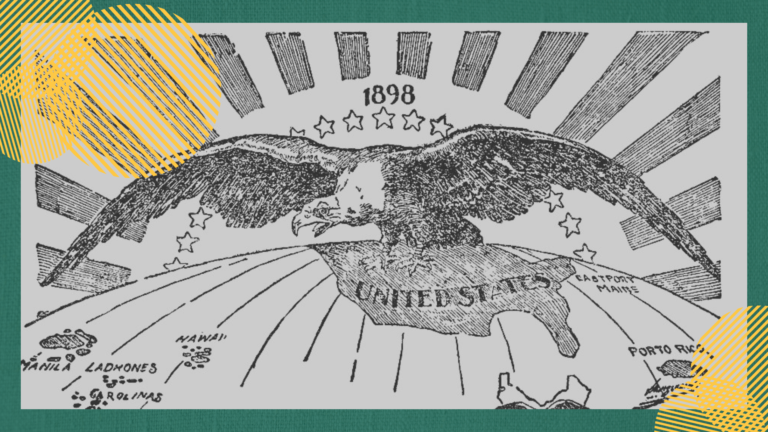
The U.S. takes Hawai'i Imperialism Lesson Plan
Students will explore the history of American expansion from the dawn of the republic through to the Age of Imperialism. Using primary sources such as George Washington’s farewell address and John O’Sullivan’s “Annexation” article, which coined the term Manifest Destiny, students examine America’s earliest foreign policy.
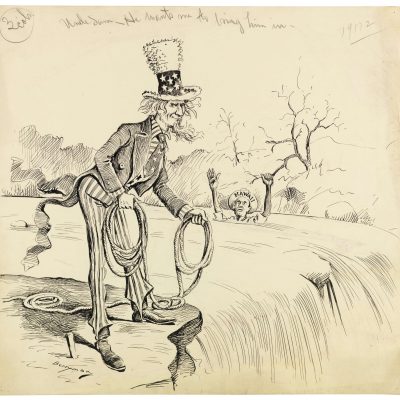
In this high school history lesson plan, students will use Hawai’ian annexation as a case study to examine the American turn toward global imperialism. Experiences in this lesson include a stations activity that uses Congressional sources detailing the role of the United States in overthrowing the Hawai’ian monarch and an analysis of political cartoons. As a summative assessment, students will create their own cartoons to answer the compelling question of the inquiry: “Has America always seen itself as an imperial power?”
This free download includes:
- Lesson Plan
- A three-day inquiry lesson that guides students through Congress’ investigation into the overthrow of Queen Lili’uokalani of Hawai’i.
- Primary Sources
- Excerpts from Washington’s Farewell Address, The Monroe Doctrine Speech, and John O’Sullivan’s Manifest Destiny article.
- Historical testimony and reports from both the United States government and Native Hawai’ian sources.
- Secondary Sources
- A timeline of U.S. territorial expansion from 1789 to 1900.
- Student Worksheets
- Activities that help students analyze witness testimony, evaluate competing political arguments, and consider how the United States saw its role in the world.
- Answer Key
- Teacher support materials that provide guidance for evaluating student responses and facilitating student creation of political cartoons for a summative assessment.
- Slide Deck
- A ready-to-use presentation that guides students through America’s turn toward imperialism and the congressional investigation into the overthrow of Queen Lili’uokalani, reinforcing key concepts for whole-class instruction.
This lesson examines the evolving role of the United States in the world from 1789 to the early 20th century. Using primary sources from both a presidential and congressional investigation into the American acquisition of Hawai’i as a case study, students explore:
- How did America view its role in the world before 1890?
- Why did Hawai’i become American territory?
- How did America view its role in the world after 1890?
This inquiry-based approach encourages students to evaluate historical evidence and consider how America’s view of its role in the world influences its actions.
How did the U.S. come to annex Hawai'i in 1898?
[...] I mistake the American people if they favor the odious doctrine that [...] there is one law for a strong nation and another for a weak one.[...] The Provisional Government has not assumed a republican or other constitutional form, but has remained a mere executive council or oligarchy, set up without the assent of the people.
President Grover Cleveland in a message to Congress opposing Hawai'ian Annexation, 1893
From the birth of the United States, through Washington’s Farewell, the Monroe Doctrine, and the embrace of Manifest Destiny, the United States had long engaged in a national conversation about its role in the world, and how it should approach national expansion. At the close of the 19th century, that conversation entered a new phase when, in 1893, a group of foreign-born Hawaiian residents (including those of American and European origin) staged a successful coup against Queen Lili’uokalani of Hawai’i, aided in part by the U.S. minister to Hawai’i’s request for U.S. Marines from the nearby U.S.S. Boston. In the aftermath of the coup, the new Provisional Government petitioned for annexation to the United States. The U.S. government (through a Presidential commissioner and later the Senate Foreign Relations Committee) investigated to determine whether the U.S. minister had acted improperly; despite conflicting reports, the government ultimately chose to annex the islands in 1898 in the wake of American victory in the Spanish-American War, which made clear the strategic importance of Hawai’i to American interests in the Pacific.
Content Standards
This lesson plan aligns with Michigan social studies content standards and supports instruction in U.S. history and civics by helping students analyze the age of U.S. Imperialism, the connection between America’s self-perception and its actions, and the role of congressional investigations in shaping public policy.
All Learning by Hearings materials are fully funded by the State of Michigan and the Michigan Department of Education.
MI USHG – 6.2.1 Growth of U.S. Global Power – describe how America redefined its foreign policy between 1890 and 1914 and analyze the causes and consequences of the U.S. emergence as an imperial power in this time period, using relevant examples of territorial expansion and involvement in foreign conflicts.
Once you fill out this form, you will be redirected to our download page.
**If you have already filled out the download form, please look in your inbox for an email from [email protected] for a link to the download page.**
Can’t see the form below? Click here to access it.