Congress Investigates September 11, 2001
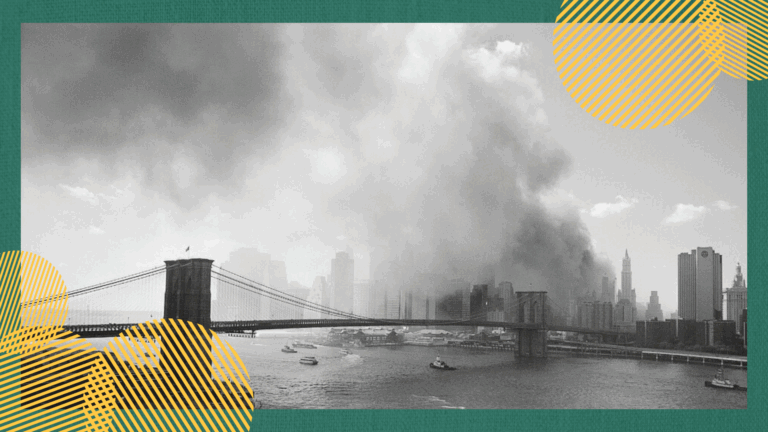
The 9/11 Investigation Lesson Plan
In this lesson, high school civics students examine how the terrorist attacks of September 11, 2001 challenged the United States government and tested the Constitution’s system of checks and balances. Students explore both the immediate government response to the attacks and the longer-term consequences of the War on Terror, with particular attention to the balance of power between the President and Congress. The lesson connects the events of 9/11 to key civic concepts including separation of powers, checks and balances, federalism, and presidential and congressional authority.
Throughout the lesson, students engage with a range of primary and secondary sources, including excerpts from the U.S. Constitution, presidential speeches, congressional responses, and media coverage. Working individually and collaboratively, students analyze these sources for evidence, summarize government actions, and categorize them as actions of the president, Congress, or cooperation between the branches. They then evaluate whether those actions demonstrate checks and balances working effectively or being tested.
The lesson is guided by the Compelling Question, “How does a crisis test the Constitution’s checks and balances?” Students use evidence gathered from the sources and their analysis of the immediate and long-term government response to 9/11 to develop and defend a claim about whether the Constitution’s checks and balances worked as intended. In doing so, students consider how a national crisis can shape the exercise of governmental power and challenge the constitutional relationships among the branches of government.

This free download includes:
- Lesson Plan
- A two-day inquiry-based lesson that guides students through an investigation of the impacts of the 9/11 terrorist attacks, examining how the threat of terrorism influenced congressional investigations, executive actions, and public policy during the War on Terror. Students analyze evidence and evaluate the impact of government decisions on the balance of power between Congress and the President.
- Primary and Secondary Sources
- Excerpts from the US Constitution (1787) Selected sections from Articles I and II that focus on military action and powers
- Headlines, video, and first-hand accounts of the 9/11 Terrorist Attacks on the United States
- Bush’s Address to Congress (9/20/01) Excerpts from Bush’s second national address following the attacks on 9/11 in which he announces the War on Terror and encourages national unity and action
- Authorization for the Use of Military Force (2001) Congressional action allowing retaliation for the attacks
- The 9/11 Commission Report (2002) Excerpts from the Executive Summary explaining congressional recommendations following the country’s first bipartisan and bicameral investigation.
- Featured headlines and commentary on the War on Terror
- Student Worksheets
- Students participate in a document anaysis and categorization activity that helps them explore a wide variety of sources. Students will read for information and find examples of congressional action, presidential action, cooperation, and checks and balances.
- Answer Key and Slide Deck
- Teacher support materials that provide sample responses, evidence-based explanations, and guidance for facilitating discussion.
Using document analysis techniques to review congressional reports and government documents, students explore the tension between Congressional and Presiential decision making. Along the way, students explore the following supporting questions:
- How did people in the United States react to events on September 11, 2001?
- How did the government react to events on September 11, 2001?
- How did the response to 9/11 expand the President’s power to take miltary action?
By the end, students answer the Compelling Question: How does a crisis test the Constitution’s checks and balances?
September 11th Snapshot
Our snapshot of the 9/11 Commission is a classroom-friendly version of our Portrait in Oversight on the same topic. Each of our snapshots is a brief summary of the historical investigation.
To enhance accessibility and support for multilingual learners, each download includes:
- Comprehension Questions
- These questions guide students through the key events of the 9/11 Commission investigation, explore who the leadership was, and identify the main findings of the report.
- Discussion Questions
- These prompts encourage deeper analysis by asking students to consider the importance of bipartisanship during times of crisis and the tension that is sometimes created by checks and balances.
- Answer Key
- Teacher support materials that provide clear responses to both comprehension and discussion questions, making it easier to review student work and facilitate classroom discussion
- Audio Recording
- The audio version presents the full snapshot narrative in an accessible format, allowing students to listen to the historical account of the 9/11 Commission. This supports different learning styles and can be used for independent review or group listening.
- Spanish and Arabic Translation
- Translated material ensures broader classroom accessibility and support for multilingual learners and inclusive instruction.
What Was the 9/11 Joint Inquiry?
The Joint Inquiry leadership strove for consensus. It worked because they were respectful of each other, they were willing to work together to reach agreement even on difficult issues, and they understood, in the wake of the attacks, how important what they were doing was to the country.
Eleanor Hill, staff director of the Joint Inquiry
On September 11, 2001, the terrorist group Al-Qaida hijacked four commercial airplanes and carried out attacks on the World Trade Center in New York by two planes, and the Pentagon in Washington, D.C. with a third. While the fourth plane crashed in a field in Pennsylvania, the terrorist attack resulted in the deaths of 3,025 people, making it the deadliest attack of its kind on American soil, and led to the first-ever joint investigation by the House and Senate intelligence committees.
The Joint Inquiry into Intelligence Community Activities Before and After the Terrorist Attacks of September 11, 2001 was formed to investigate the intelligence failures that led to the attacks. Led by Democratic Senator Bob Graham and Republican Representative Porter Goss, the so-called “Big 4” leadership team was rounded out with Republican Senator Richard Shelby and Democratic Representative Nancy Pelosi. The deliberately bipartisan inquiry aimed to figure out what the intelligence community knew or should have known prior to 9/11, identify systemic problems, and recommend improvements to prevent future attacks. It was decided from the outset that all decisions would be unanimous.
Content Standards
This lesson plan aligns with Michigan social studies content standards and supports instruction in U.S. history and civics by helping students analyze how the attacks on 9/11 and the response to terrorism have altered American international policies.
MI USHG – 9.2.2 9/11 and Responses to Terrorism – analyze how the attacks on 9/11 and the response to terrorism have altered American domestic and international policies.
MI Civics 3.1.4 – Examine and evaluate the effectiveness the role of separation of powers and checks and balances in regard to the distribution of power and authority between the three branches of government.
Once you fill out this form, you will be redirected to our download page.
**If you have already filled out the download form, please look in your inbox for an email from [email protected] for a link to the download page.**
Can’t see the form below? Click here to access it.